

Jaipur Metro Turns 11 Years Old in 2026
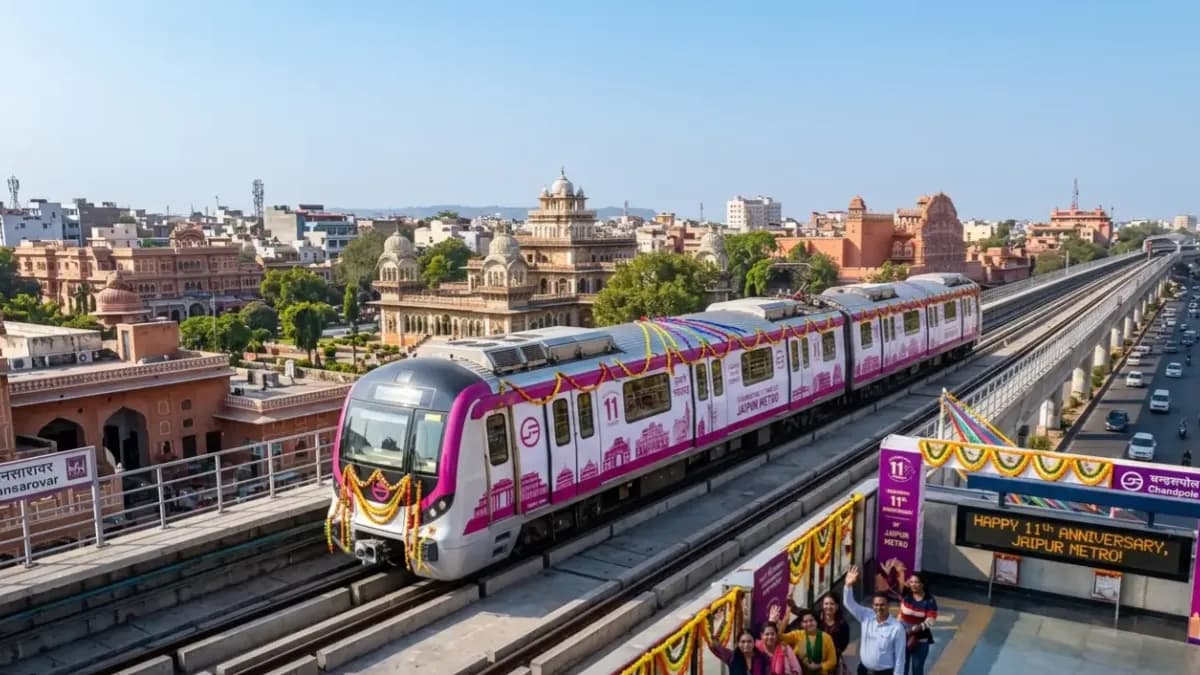
On June 3, 2026, Jaipur Metro quietly crosses a milestone that most cities would celebrate loudly - 11 years of uninterrupted metro rail service in the Pink City.
What started as a bold infrastructure project in 2011 has grown into a daily lifeline for tens of thousands of Jaipur residents. From the first trial run in 2013 to the completion of the underground Phase 1B stretch in 2020, the Jaipur Metro story is one of gradual but steady progress.
If you've ridden the Pink Line between Mansarovar and Badi Chaupar, you've been part of that story. This article looks back at how far the Jaipur Metro has come - and what the next chapter looks like.
How It All Began: The Early Years of Jaipur Metro
The groundwork for Jaipur Metro started in 2010, when the Jaipur Metro Rail Corporation (JMRC) was formally established on January 1 of that year. Construction of Phase 1A kicked off on November 13, 2010, covering 9.63 km from Mansarovar to Chandpole Bazaar, mostly on elevated tracks.
Trial runs began on September 18, 2013, and were flagged off by then Chief Minister Ashok Gehlot. After clearing safety checks by the Commissioner of Metro Rail Safety (CMRS) in May 2015, the metro was inaugurated for public use on June 3, 2015 by then Chief Minister Vasundhara Raje.
A notable distinction worth knowing: Jaipur Metro is India's sixth metro rail system, after Kolkata, Delhi NCR, Bangalore, Gurgaon, and Mumbai. It also holds the distinction of being the first metro in India to run on a double-storey elevated road - metro tracks built above an existing road flyover.
That's not a small achievement for a city like Jaipur.
The Pink Line Today: 11 Stations, 11.97 km
As of 2026, the operational network consists of the Pink Line, also known as the East-West Corridor, running from Mansarovar in the west to Badi Chaupar in the east. You can view the full Jaipur Metro route map to plan your journey.
Here's a quick look at the current network:
- Total operational length: 11.97 km
- Total stations: 11
- Track type: Elevated (Phase 1A) and Underground (Phase 1B)
- Daily ridership: approximately 55,000 passengers (July 2024 data)
- Train frequency: every 10 minutes during peak hours, 15 minutes off-peak
- Operating hours: 6:00 AM to 9:00 PM
Check the latest Jaipur Metro train timings before you travel especially useful during public holidays when frequency can vary.
The underground section from Chandpole to Badi Chaupar, known as Phase 1B, was completed and opened to the public on September 23, 2020. This 2.34 km stretch added two underground stations Chhoti Chaupar and Badi Chaupar and completed the full Pink Line corridor.
Jaipur Metro Fares: Affordable Urban Travel
One of the most practical reasons commuters choose the metro over auto-rickshaws or cabs is the fare structure. JMRC keeps fares accessible for daily users.
Current fare ranges on the Pink Line:
- Minimum fare (1 to 2 stations): ₹10
- Short trips (up to 5 stations): ₹15
- Medium trips (6 to 8 stations): ₹25
- Full corridor (Mansarovar to Badi Chaupar): ₹30
Use the Jaipur Metro fare calculator to check the exact fare between any two stations before you travel.
Tokens are available at all stations. Regular commuters can also buy metro tickets online or use the JMRC Smart Card, which offers a 10% discount on every journey and skips the queuing for tokens.
Key Stations Worth Knowing
The 11 stations on the Pink Line each serve distinct parts of the city. Here are the most-used ones:
Mansarovar:Western terminus; major residential hub; interchange for buses heading towards Ajmer Road and Vaishali Nagar.
Vivek Vihar / Shyam Nagar: Mid route stations serving dense residential colonies west of the city centre.
Civil Lines: Serves the high footfall area near Sindhi Camp bus stand and central Jaipur shopping zones.
Railway Station: One of the busiest stops on the entire line; connects directly with Jaipur Junction, making it a go-to for tourists arriving by train.
Sindhi Camp: Adjacent to the intercity bus terminal; useful for those switching between metro and state roadways.
Chandpole: Gateway to the walled city; close to Chandpole Bazaar and historical entry points.
Chhoti Chaupar and Badi Chaupar: Underground stations serving the heart of the Old City; ideal base for exploring Hawa Mahal, Jantar Mantar, and City Palace.
For tourists, this eastern end of the Pink Line is genuinely useful. Badi Chaupar puts you within walking distance of most of Jaipur's UNESCO listed and heritage grade attractions.
Jaipur Metro and Tourism: A Practical Travel Option
Jaipur sees millions of domestic and international tourists every year. The metro has become a practical option for travellers who want to skip taxi negotiation and traffic jams in the old city lanes.
How tourists typically use the line:
- Arrive at Jaipur Junction and board at Railway Station metro stop
- Travel to Badi Chaupar for direct access to Hawa Mahal, Jantar Mantar, and City Palace
- Return via metro to Railway Station for onward journeys
Explore our guide to tourist attractions near Jaipur Metro stations for a full breakdown of what's within walking distance of each stop. If you're planning a full day out, check our Jaipur Metro itineraries they cover the most efficient ways to cover the city using the metro.
The metro runs air conditioned 4 coach trains, which is a relief during Rajasthan's intense summers. If you're staying near a station, also browse hotels near Jaipur Metro for convenient accommodation options.
11 Years of Progress: Key Milestones
Looking back at what JMRC has achieved since 2015:
- 2010 - JMRC established
- 2011 - Construction of Phase 1A begins
- 2013 - Trial runs commence
- 2015 - Public launch on June 3; Mansarovar to Chandpole operational
- 2018 - Full planning for Phase 1B complete
- 2020 - Phase 1B opens on September 23; Badi Chaupar becomes the eastern terminus
- 2024 - Daily ridership crosses 55,000 passengers
- 2025 - Phase 1C construction advances with first pier cap casting; bids invited for traction systems
- 2026 - 11 years of continuous operation
That ridership number - 55,068 daily passengers as of July 2024, shows real, growing dependence on the system. When the metro first opened in 2015, ridership was significantly lower. The consistent growth reflects increased public trust and urban expansion along the corridor.
What's Next for Jaipur Metro: Phase 1C, 1D, and the Orange Line
The next few years will define whether JMRC can scale meaningfully.
Phase 1C extends the Pink Line from Badi Chaupar to Transport Nagar, a 3.41 km stretch with one underground station at Ramganj Chaupar and one elevated station at Transport Nagar. Estimated project cost is around ₹856 crore. Construction is underway, with completion now expected around 2027.
Phase 1D proposes an extension from Mansarovar towards Ajmer Road, improving connectivity to the city's western growth zones.
The Orange Line (Phase 2) is the most ambitious plan a 23.1 km north south corridor from Sitapura Industrial Area in the south to Ambabari in the north, with 21 stations planned. Once complete, it would nearly triple the network's reach. Full operationalisation is expected around 2028, though timelines have shifted before.
If both expansions stay on track, Jaipur Metro will eventually cover 35 stations across 40.25 km, a significant upgrade from where it stands today. Follow our Jaipur Metro guides for updates as new phases progress.
FAQs About Jaipur Metro
When did Jaipur Metro start operating?
Jaipur Metro began public operations on June 3, 2015. The first section ran between Mansarovar and Chandpole as part of Phase 1A.
How many stations does Jaipur Metro have in 2026?
There are currently 11 operational stations on the Pink Line, running from Mansarovar (west) to Badi Chaupar (east). See the full list of Jaipur Metro stations with details for each stop.
What are the metro timings in Jaipur?
The metro runs from 6:00 AM to 9:00 PM daily. During peak hours, trains arrive every 10 minutes; during off-peak hours, the gap is around 15 minutes. Check the complete timing schedule for the latest updates.
What is the fare for Jaipur Metro?
Fares range from ₹5 to ₹20 depending on distance. Use the fare calculator to get the exact fare between your stations. A JMRC Smart Card gives a 10% discount on every trip.
Which metro station is closest to Hawa Mahal?
Badi Chaupar is the closest metro station. From there, Hawa Mahal is around a 5 to 10 minute walk or a short auto-rickshaw ride.
What is Phase 2 of Jaipur Metro?
Phase 2 is the planned Orange Line a 23.1 km north-south corridor with 21 stations connecting Sitapura in the south to Ambabari in the north. It is in the tendering and approval stage as of 2026.
Conclusion
Eleven years is not a long time in infrastructure terms, but Jaipur Metro has accomplished something that many cities in India take decades to build a reliable, affordable rapid transit system in a heritage dense, tourist heavy city.
The Pink Line today carries over 55,000 commuters daily. It connects residential zones in the west to the commercial and historical heart of the old city in the east. And with Phase 1C under construction and the Orange Line approved, the network's best years are still ahead.
Whether you're a daily commuter or a first time visitor planning a trip to the Pink City, the metro is the simplest, most efficient way to move around Jaipur.
Explore our complete Jaipur Metro guides, use the fare calculator to plan your trip, or check train timings before you head out everything you need is right here on JaipurMetro.com.
Related Metro Guides
How to Travel by Jaipur Metro
First-time rider? Tokens, smart cards, and platform tips.
Sightseeing by Metro
Nearest stations for Hawa Mahal, City Palace, and more.
Fare Calculator and Prices
Complete fare chart with discount breakdowns.
Metro Schedule and Frequency
First train, last train, and peak hour timings.
Explore Jaipur Attractions
View all attractionsTravel Guide
Jaipur Travel Guide 2026
Attractions, food, shopping, budget planner, and 3-day itinerary for the Pink City.