

Jaipur Metro Phase 2 Inauguration Everything You Need to Know
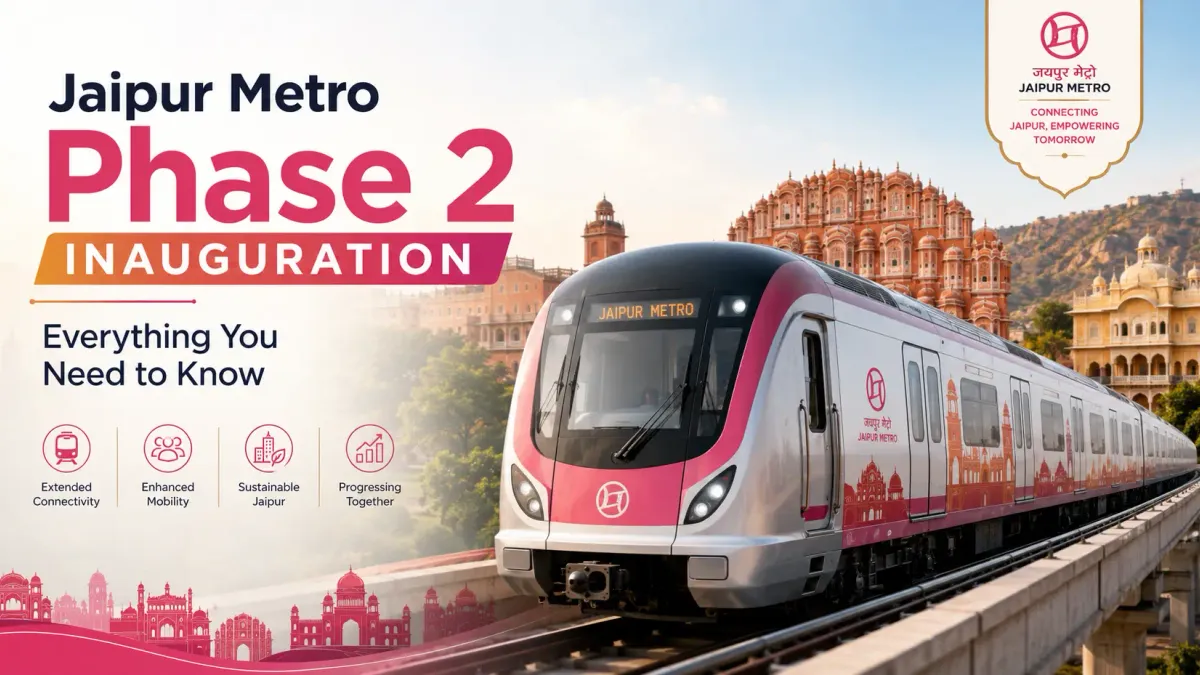
Jaipur is on the verge of its biggest urban transport leap since 2015. After over 14 years of planning, revisions, and anticipation, Jaipur Metro Phase 2 is finally becoming a reality. Prime Minister Narendra Modi is set to lay the foundation stone for the project on July 4, 2026, marking the official start of a ₹13,037 crore transformation for the Pink City.
For daily commuters stuck on Tonk Road, for residents of Sitapura and Vidhyadhar Nagar, and for the thousands who travel between the city's industrial zones and residential neighbourhoods, this is long-overdue news. Here is everything you need to know about the Jaipur Metro Phase 2 inauguration, the route, the stations, and what this means for the city.
What Is Jaipur Metro Phase 2
Jaipur Metro Phase 2 is the much-awaited Orange Line, a new 41 km north-south corridor connecting Prahladpura in the south to Todi Mod in the north. The project comprises 36 stations and will be implemented by Rajasthan Metro Rail Corporation Limited (RMRCL), a 50:50 joint venture between the Government of India and the Government of Rajasthan.
Unlike Phase 1 (the Pink Line), which runs east-west across 11.97 km, Phase 2 will cut across the city's busiest north-south spine, connecting major industrial zones, the airport, hospitals, and residential hubs in a single continuous corridor.
Why This Project Matters
Jaipur's road network has been under severe strain. Tonk Road, Sikar Road, and the Sanganer stretch are among the most congested arterial roads in the city. Phase 2 is expected to significantly reduce traffic congestion, lower vehicular emissions, and enhance mobility for residents, workers, and tourists alike.
For context, Jaipur Metro Phase 1 currently records an average daily ridership of around 60,000 passengers on its 11.64 km corridor. Once the 41 km Orange Line is operational, that number is expected to multiply several times over.
The Foundation Stone Ceremony on July 4 2026
Chief Minister Bhajan Lal Sharma announced that Prime Minister Narendra Modi will lay the foundation stone for Jaipur Metro Phase 2 on July 4, and that work orders have already been issued for the Prahladpura to Pinjrapole Gaushala corridor of the project.
PM Modi's July 4 visit will also include dedicating the Pachpadra Refinery to the nation and inaugurating other development projects across Rajasthan, making it one of the most significant development events the state has seen in recent years.
This is not just a symbolic moment. Work orders are already in place, tenders for the first priority section are in process, and the project has received full Cabinet approval. The July 4 ceremony officially marks the transition from planning to construction.
Jaipur Metro Phase 2 Route and Station Overview
The Full 41 km Orange Line
The Orange Line will be 41 kilometres long and serve 36 stations when complete, connecting Prahladpura in the south to Todi Mod in the north via Jaipur International Airport, Ambabari, and SMS Hospital. It will have 2 underground stations, while the rest will be elevated.
Key nodes along the route include:
- Sitapura Industrial Area — one of Jaipur's biggest employment hubs
- Jaipur International Airport — with dedicated underground stations for seamless connectivity
- SMS Hospital and Stadium — serving lakhs of patients and visitors annually
- Ambabari and Vidhyadhar Nagar — dense residential zones in north Jaipur
- VKIA (Vishwakarma Industrial Area) — another major industrial corridor
- Chandpole — planned interchange with the existing Pink Line
Spanning approximately 32 kilometres of elevated track and a strategic underground section near Sanganer Police Station on Tonk Road, the line will facilitate direct access to Terminal 1 of Jaipur Airport.
The First Priority Section
Construction will not happen all at once. The Rajasthan Metro Rail Corporation has smartly divided the entire project into 4 distinct phases, with the first priority stretch being the 12 km corridor from Prahladpura to Pinjrapole Gaushala on Tonk Road.
This stretch will cover 10 stations including Manpura, Bilwa Kalan, Goner Mod, Sitapura, and JECC, directly serving the industrial and commercial spine of Jaipur's southern belt.
Project Cost and Funding Structure
The total project cost is ₹13,037.66 crore. Funding is structured through equity support from the Government of India and the Government of Rajasthan, subordinate debt, and multilateral financing, in accordance with the Metro Rail Policy, 2017.
The project has cleared several rigorous evaluations, including Inter-Ministerial Consultation, Network Planning Group review, and Public Investment Board assessment. The project has an Economic Internal Rate of Return (EIRR) above the threshold of 14%, indicating strong socio-economic viability.
Simply put, this is a financially sound project backed by both central and state governments.
Completion Timeline and Construction Phases
Jaipur Metro Phase 2 is targeted for completion by September 2031.
Here is a broad roadmap based on current updates:
Milestone Expected Timeline Foundation Stone Laying July 4, 2026 Civil Work Begins (Phase 1 Section) Late 2026 or Early 2027 First Section (12 km) Operational 2029–2030 (projected) Full 41 km Corridor Complete September 2031 (target)
After nearly 14 years of planning and revisions, construction of Jaipur Metro Line 2 is finally moving forward with the DPR finalised and tenders in process.
How Phase 2 Connects with Phase 1 (The Pink Line)
The current Pink Line runs from Mansarovar to Badi Chaupar across 11.97 km with 11 stations. Trains run from approximately 6:00 AM to 10:00 PM, and fares range from ₹10 to ₹30. Smart card holders get a small discount over single-ride tokens.
Phase 2 will integrate with this existing network through a planned interchange at Chandpole station. Phase 2 will integrate with the operational Phase 1 through planned interchanges and feeder systems, ensuring a unified and continuous metro network across the city.
This means commuters will eventually be able to board at Mansarovar and connect to Sitapura Industrial Area or the airport without stepping out of the metro system.
Impact on Jaipur's Urban Life
For Daily Commuters
Residents of Sitapura, Sanganer, Ambabari, and Vidhyadhar Nagar currently spend 45 to 90 minutes navigating congested roads to reach the city centre. The Orange Line will cut this to under 30 minutes for most stretches.
For Tourists
Jaipur welcomes millions of tourists every year. Airport connectivity via metro is a massive upgrade. Visitors arriving at Jaipur International Airport will be able to hop directly onto the Orange Line and reach major landmarks like Chandpole and the Walled City area with a single interchange.
For Property and Business
Areas along the Phase 2 corridor, particularly around Tonk Road, Sitapura, and Sikar Road, are already seeing increased property interest. Infrastructure-linked real estate growth is well-documented in Indian metros, and Jaipur is no exception.
Frequently Asked Questions
When will Jaipur Metro Phase 2 open for passengers? The full 41 km corridor is targeted for completion by September 2031. The first 12 km priority section connecting Prahladpura to Pinjrapole Gaushala on Tonk Road is expected to be ready by 2029–2030.
Who will lay the foundation stone for Jaipur Metro Phase 2? Prime Minister Narendra Modi will lay the foundation stone on July 4, 2026, during his visit to Rajasthan.
What is the total length and number of stations in Phase 2? Phase 2 covers 41 km with 36 stations, running from Prahladpura in the south to Todi Mod in the north.
What is the total cost of Jaipur Metro Phase 2? The approved project cost is ₹13,037.66 crore, funded jointly by the Central and Rajasthan state governments along with multilateral financing.
Will Phase 2 connect to the existing Pink Line? Yes. A planned interchange at Chandpole station will link the new Orange Line with the existing Pink Line, creating a unified metro network across Jaipur.
What major landmarks will the Orange Line cover? Key stops include Sitapura Industrial Area, Jaipur International Airport, SMS Hospital, Ambabari, Vidhyadhar Nagar, and VKIA.
Will the Phase 2 metro have underground stations? Yes. There will be 2 underground stations, primarily in the airport area near Sanganer, to maintain flight path clearance.
Who is implementing Jaipur Metro Phase 2? RMRCL (Rajasthan Metro Rail Corporation Limited), a 50:50 joint venture between the Government of India and the Government of Rajasthan, will implement the project.
Conclusion
Jaipur Metro Phase 2 is not just another infrastructure project. It is the missing north-south spine that the Pink City has needed for over a decade. With PM Modi laying the foundation stone on July 4, 2026, the Orange Line is finally moving from blueprint to reality.
For commuters, the wait is nearly over. For tourists, airport-to-city metro travel is on the horizon. For Jaipur as a whole, this ₹13,037 crore project signals a future where the city moves faster, cleaner, and smarter.
Stay connected with JaipurMetro.com for the latest updates on Phase 2 construction progress, station-by-station route guides, fare details, and everything you need to navigate Jaipur by metro. Explore our other guides on Pink Line timings, smart card benefits, and metro station parking to plan your journeys today.
Related Metro Guides
How to Travel by Jaipur Metro
First-time rider? Tokens, smart cards, and platform tips.
Sightseeing by Metro
Nearest stations for Hawa Mahal, City Palace, and more.
Fare Calculator and Prices
Complete fare chart with discount breakdowns.
Metro Schedule and Frequency
First train, last train, and peak hour timings.
Explore Jaipur Attractions
View all attractionsTravel Guide
Jaipur Travel Guide 2026
Attractions, food, shopping, budget planner, and 3-day itinerary for the Pink City.